Pages

Showing posts with label Sweden. Show all posts

Jul 26, 2010

You know you live in the country when


- you know how many cars pass down your street a day.

- the church and it's affilliated buildings are the focalpoints.

- the priest calls you and asks why you never go to service and you feel it'd be awkward if you were honest and said you don't actually believe in God.

- the main forms of transportations are moped and tractor.

- you notice when the cashier in the store has new shoes.

- you shop at the dinky store because you don't feel like driving 12 mins to the supermarket.

- you feel bad for slamming your front door at 9 pm.

- your neighbour somehow feels he has the right to tell you need to shovel in straighter lines.

- your mailman asks you why you get so much mail from a particular company.

- the kiosk attendant automatically puts up what you usually buy on the counter.

- you check the window of the pizzeria owner's apartment through yours to see if they're open.

- everyone plays football because there's nothing better to do.

- the main weekend activity is car bingo.

- people ask you what kind of dogs you have when you take your cats for a leashed walk.

- your old classmates all live on the same street as you.

- a trip to Ibiza is considered to be educational as to what's going on in the world.

- the local paper's headline is "Graffiti on train" or "Man falls off bike".

- the library is only open twice a week, closed all summer.

- you can tell it's 5 pm because the streets are empty and you smell cooking.

- you see more sweatpants than dresses.

- you know which kid belongs in which house by the sound of their voices.

- people still shake their heads in wonder about the family with seven kids. The kids are now in their 50s.

- you're an outcast if you don't go to the Christmas fair.

- you wave at cars, not people.

- there are no buses on Sundays. Or holidays.

- you give directions such as "At the Holmgren farm, turn left towards the mill, at Svensson's flowery mailbox turn left again, then straight ahead past the Håkansson place".

- the cows wake you up every morning.

- most people wake up around the time you go to bed.

- you panic when you have to drive in a city.

- you can't crack jokes about anything that's happened in the past 20 years further away than 5 km from the store.

- people laugh at your clothes, then wear the same thing five years later.

- everyone knows who's sleeping with who.

- it's not called "sleeping with", it's called "you know".

- people avoid you like the plague when someone you know has died, but walk up and pat your shoulder at the cemetary.

- you can forget to lock your back door for a week and nothing happens.

- you've never been to the restaurant because it's only open from noon til 4 pm.

- if you have dark hair and eyes people often ask you where you're really from and look confused when you say "Stockholm" and then ask "Yes, but originally"

- you don't count unless your family goes back at least four generations in the same place.

- people mispronounce the word "originally".


- people say "det lade sardin på stämningen" instead of "det lade sorti på stämningen" and are utterly serious.

- you're considered exotic because you can tell the difference between a papaya and a coconut.

- you can ask any random person for your phonenumber in case you forgot it.

- there's no cellphone reception except for one provider.

- everything's done "for the community", may it be donating money to Haiti (yes, they just realised it happened) or going the speedlimit past the daycare.

- it's all really just a small collection of houses among trees and fields.

- you feel compelled to write a list like this.

Jul 19, 2010

Beauty and nationality


I just read the silliest article about which country is the most beautiful. If you wish to read it for yourself, do so here, you won't get any wiser. However, while Sweden slipped to a 6th place and the examples given for what Swedish beauty is I noticed something else. It's the idea of beauty that must have changed while the classic blond hair and blue eyes isn't valued as highly. Countries such as Spain, Italy and Brazil have better positions. (As far as I could tell Norway wasn't on the list at all) Other classically blond countries like Holland and Germany finished last and second to last.

Why is this? There must have been a shift in the concept between the blonde and the brunette. Does it have to do with that the natural blond comes from a recessive gene that'll die out, and is ment to do so due to what we're attracted to? Something else it makes me wonder about is how much nationality we can read into someone's apperance. Do I look like the typical Swede? I know I don't fit the stereotype of it. I'm not overly tall, my eyes aren't blue, I'm not blond and my bosom should be left out of this. Does this lessen my swedishness or does it instead enhance the new type of Swede? The one that will come about with new generations while our immigrants become just as Swedish as us due to having their children here and them growing up here. I have generally said that if your parents were born in Sweden and you were as well, you're just as Swedish as I am. Even though I have more generations born here it doesn't make this country any more mine than anyone else's.

Another aspect is the internationalization process. Sweden's always been on top of technology, for instance we're the country with the most computers per capita in Europe, we also have something like 11 million mobile phone users, but only a 9 million people population. There is a simple explation to that, can you figure it out? What I was getting at was that we're now exposed to so many different looks, it's not all what's around us. And with Sweden being so accepting of imported music, movies, tv-shows and gossip we've just as accustomed to the darker hair and complexion.

This is something that has happened in my lifetime, or even during the years I've been an adult. Maybe I do owe the emo kids with dyed black hair some credit. I don't really believe we're attracted to the exotic per se, sure, part new mixed with something familiar, or attraction becomes too animalistic. Something I'm personally fine with, but is the average levelheaded Swede ok with that, apart from when they go on holiday and hook up with some monkey looking man they can't communicate with. Yes, that's right, the study verymuchalmostcompletelyIhadtolookseveraltimestoseeamalenamefocused on the beauty of women. At least the world of beauty hasn't changed that much, it's still women who are judged on their apperance.

And, oh yeah, Greta Garbo wasn't blond, neither was Ingrid Bergman. Even Sweden has blond in a bottle.

Jul 13, 2010

Summer, how I hate you.


You're the fickle mistress of an entire people. They worship you as if you were a goddess, they wait for you, long for you, plan for you, celebrate your arrival. What do you offer in return? Scorching heat or pouring rain. Mosquitoes, wasps, peeling skin, naked children, flipflops with socks, closed hospitals, caravans tipping on bridges, ice cream stained asphalt and arguments in cars.

No, summer, I'm not charmed. No flowers can compensate the autoreplies I get from e-mailing the university. No heat can justify me in a bikini on a square. I hate you, detest you, loathe you. You're the barbed wire I have to crawl through to get to the air at the end of the tunnel. Autumn, I will embrace you this year in ways I never have before.


As a mistress you have twisted their heads, summer. They can't see you for what you are, you lying good for nothing whore.

May 19, 2010

Whose misery can we laugh at?


Sometimes the only option we have is to laugh at things no matter how tragic they are. But who can we safely laugh at? Perhaps the model of news can be useful. The more likely we are to read an article has to do with ho close the event is how close in time, how close phusically and how close to intrest. The relation should be opposite. We can laugh at things far away in time place and so on and so forth.

This isn't entiely true though, right after 9/11 there were jokes circling around the Internet, within days, perhaps even hours. Defensive sarcasm. The best humor is a bit evil. But do we say mean things in jokes just because we really think it's true? Stand up comedy is based on generalizations. We laugh even though we know it isn't exactly like that, but it's so great when someone's on a stage being judgemental and mean. It makes us feel better for laughing at "them".

Naturally "they" are so much less complex than "we" are. They're homogen, we're all different. The further away they are the larger these groups get. All the people from Huddinge are the same, all the people from Stockholm are the same, all the people from the coast are the same, all the people from Sweden are the same, all the people from Scandinavia are the same, all the people from Europe are the same. Again, it all depends on your perspective. I'm not denying that there are similarites, but at the same time I think we're more united in our differences than the things we have in common.

To get back to the original question, who is it ok to make jokes about. I tend to say "enough food to feed a small African village", and people laugh! Every time I do my stomach turns a little. I know it's wrong but I want those points of approval. You can't really have in depth conversations with someone when you don't know their values, can you? Is it ok to make jokes about Indians when you're in your safe house in Sweden? Is it ok to joke about judgemental Americans when you're really just being as judgemental yourself for joking about it?

Naturally, it's always ok to joke about the stupidity of Norwegians. They must deserve it, I can't think of any other reason why there'd be so many jokes to tell about them

Apr 28, 2010

Redemption and to be forgiven

SVT1 aired a documentary/interview with Annika Östberg yesterday. Prior to this two other documentaries had shown her life, how she ended up where she did, but we didn't really get to hear her speak. She was asked if she had any regrets, and she said something down the lines of "of course, don't we all, but I'm more sad that my mistakes effected me in the ways they did, and effected other people the way they did". I found something in that, maybe not the obvious. The consequences are often what we're upset about. If the outcome is good we rarely concider it a mistake, it's a fortunate turn of events, a chance, a break.

The fact that she was locked up for as long as she was, 30 years or so also raised a few other trails of questioning in me. When are forgiven in a human perspective? I'll leave the divine to someone else that knows more about it than I do. I'm not interested in what she was convicted of in that sense either, but the crime involved was murder. She was present when two murders took place. (I'd like to add that she doesn't deny involvement, but she didn't pull the trigger). Either way it went down she was in a situation that cost two people their lives. Naturally the person the American authorities was more upset about was the police officer. But that's a whole other can of worms. So, basically, she spent 28 years in American prison and 2 years in Swedish prison and now she's in rehabilitation, a life rehab. I can't shake the feeling that there's no way to be forgiven. At the same time I know that locking me up with my own thoughts for 3 decades is more punishment than I could bear, especially if those thoughts are about my guilt for someone else's life. Is that humane? Or is the whole point that it's not supposed to be humane?

How do the families of the victims move on as long as the person that caused the dead of their loved ones is locked up, doesn't that create a neverending present? Losing family members and friends to death is something we'll all experiance, and yes sometimes it's lovely to have someone to blame. So I quickly jump onto the next lilly pad of, should we hold on to that pain forever? Maybe it's simple math. You're guilty and should beat yourself up for as long as the person whose life you took should be alive. Meaning that if you kill someone in their 60s your guilt is shorter than if you kill someone in their 20s. I'm not sure I like that equation though. Murder is the extreme of the harm people do to each other, isn't it? I'd like to think that he worst prison guard a person can have is oneself, but maybe that doesn't apply to everyone. I can only think that 30 years of your whole existance being the consequence of one fatal mistake is more harsh than a physical punishment. It is however possible that I think so only because I know what mind demons can do to a person. How to remain sane while having the worst representation of oneself being the entire you must be close to impossible.

Back to holding on to the greif. Of course I see the need to punish people for murder. But to what extent? What gives the families of these victims the right of the possibility to hold on it for so long? The period of grief after death is two years. I'm still within that period, technically. Would I like to be reminded of that death? No. Not at all. Would I like to be reminded of the death 11 years ago? No. The death 18 years ago? No. To hold on to all that anger for 30 years! That's impressive! How is that reminder helping the families. Perhaps I'll never fully understand it. I thought forgiving is divine. (Couldn't stay away from the divine, could I?) It brings yet another thing to mind; being the bigger person and accepting life as it happens.

What mistakes do, and the consequenses of them is that it seperates people into good and bad. Bad people are easy to identify. They're in prisons, they're homeless, they swear. Not quite. If it was that easy to seperate the good and the bad I would have had plenty more good nights than I can testify to. The sad bit in is that once you've been labeled as a bad person it's hard to get a chance to be a good one. You're forever stuck in the negative so to speak. You're going to be compensating for that bad thing you did. Simple example most of us have seen; the former drug addict going to schools telling the students how bad drugs are and all the things the drugs made him/her do. (Does anyone else recognize the line of "It started with a cigarette"?) Forever compensating for the bad with the good, and always being reminded of it. Just like a beggar is stuck compensating the money received with putting up with the disgusted looks from the givers.

By now it might seem that I think we should let all prison doors open and abolish all punishments, but that's not what I mean at all, I'm simply using crime as an example for things we all do. Every time you say "I'm sorry" you're compensating your bad.

Should we really be judged on our worst moments instead of our best ones? To me the answer is evident.

Feb 10, 2010

Speaking of stupid stuff...

It never ends... I read this article, basically saying that a conscript was left standing in rain and cold saluting without gloves. This gave him a 1% disability and he recived 12 000 kr from the government for his handicap.

I love newspapers, the full story is never told. I wonder, why was he out there, why wasn't he wearing gloves, why for an hour, is it possible to get disabled from saluting in the cold? There has to be more to this story. Oh it did say that he was out there for an hour. An hour in the cold makes you handicapped. Good to know. Thank you.

Feb 3, 2010

Iron-y in the loyalty

In order to remain neutral Sweden had to promise Germany that the supply of iron from Norrland wouldn't subside, so in that Germany took Norway and Denmark, while Sweden promised not to interfere. By 1944 Sweden had gotten 40 tons of gold from Germany. I guess that's the price for throwing out all loyalty. 60% of the iron Germany required after 1933 when Hitler decided to ignore the deal made in Versailles and rebuild the army came from mines in Sweden. Germany was with that depending on supplies from Sweden, and occupying Denmark and Norway was a strategic move to keep the route between Sweden and Germany open.

So basically, in order to not be occupied by Nazi Germany Sweden had to promise to give NG what they wanted. In exchange for gold, of course. Naturally there are two sides to this. Of coure I think that Sweden should have helped their neighbours. But for what, really? Would the outcome have been any different. Sweden grew richer and the following decades the economy was blooming. What would Sweden's identity have been had it acted differently during WWII?

Another aspect to concider is Sweden's historically close relationship with Germany. At the time for the war German was more widely known than English among the Swedish public. Alliances grow through common intrests. We see the same in more current events. Three countries, US, UK and Iraq. Need I say more?

Leaving history and politics to the side, people are just people, and yes we're loyal to our friends, but we sometimes need to ask ourselves, what's a friendship worth, and whose dead body am I willing to walk over to get what I want?

Jan 14, 2010

More morbid stuff


No this post isn't about Darin. No matter how morbid he makes me feel. It's about the DNA testing of seven people buried in Riddharholmskyrkan. The testing is to establish their relation to Birger Jarl. He's been dead for close to 800 years, but appearantly being related to him is so important that ... Nevermind, let me unwind. He's the father of Magnus Ladulås so I guess that's why it matters. Why it matters I don't know really. Must we be opening graves up? I mean it obviously takes very long to be buried in Sweden, and then we have to be dug up again because of those exceptional things we did. How do you feel about that Moder Svea?

They're also going to open Karl XII's sarcophagus to examine the bullet that killed him. So much for the honor of Sweden's warrior king. Do they say "rest in peace" because the body is still there, in the ground somewhere to help rest the minds of those who still have questions about the past?

Hela livet var ett disco - Markus Krunegård

I don't have that much to do to occupy my time with right this second, so I'll spread the gospel of Swedish music. Yet again.


Don't worry, the translation is further down, just scroll, that is if you prefer the English translation to the Swedish original. How are you doing on learning Swedish, by the way?

På det fyrastjärniga hotellbadrummet
Vätternstrand i bibelbältet
I det skoningslösa lysrörsljuset
kom beslutet om slutet för dig och mig

Det smakar plast, rök och sprit i din mun
När du pratar verkar du jättedum, och du är alldeles för ung
Men det får duga i natt för båda vet att
Det här betyder ingenting

Kicken, var är den?
Kicken, vart tog den vägen?

Hela livet var ett disco, men hur kunde det bli så svårt?

Fastnar med hjulen i spårvagnsspåren
Framför teven, slickar såren
Norrköping är drogavvänjning
Nej, gud, jag har inte blivit märkvärdig, inte alls
Men farten i mig är värre nu,
hjärnan behöver mer för å ha kul
Dricker te och pratar högt på finska
Jekka är smart och fattar det mesta, så jag testar, hörredu

Kicken, var är den?
Kicken, vart tog den vägen?

Hela livet var ett disco, men hur kunde det bli så svårt?

Ryggen mot väggen, tittar på sista dansen
På vägen hem lovar jag mig själv igen
att nästa vecka bjuder jag upp nån, vem som helst!

Hela livet var ett disco, men hur kunde det bli så svårt?

The whole life was a disco

At the four-star hotel bathroom
Vätterstranden in the bible belt
In the merciless fluorescent light
the decision was made for the end of you and me

Your mouth tastes like plastic, smoke and alcohol
When you speak you seem really stupid, and you are too young
But it'll do for tonight, both of us know that
This means nothing

The kick, where is it?
The kick, where did it go?

Whole life was a disco, when did it become so complicated?

The wheels of the tram sticking in the tracks
In front of the television, licking wounds
Norrköping is drug detoxification
No, god, I have not been remarkable, not at all
But the speed of me is worse now,
the brain needing more of the fun
Drinking tea and speaking loudly in Finnish
Jekka is smart and gets most things, so I try, you see.

The kick, where is it?
The kick, where did it go?

Whole life was a disco, when did it get so complicated?

Back to the wall, watching the last dance
On the way home, I promise myself once more
that next week, I'll ask someone to dance, anyone!

Whole life was a disco, but how could it be so hard

Not that I completely relate to these lyrics. Kind of fun I suppose, how we get tangled in the nets of our own lives. It's worth a thought, or a song or two.

Jan 13, 2010

Time, again

On my usual hunt for something to read I came across this, an article about the time passing between death and the funeral. I can honestly say it's not something I think about daily. Apperantly, in Sweden, the average time is 20.2 days. Both Norway and Denmark have an 8 day limit. How the compliance in relation to this is, I don't know. But in time of grief one day can seem long enough and the funeral is a way to say goodbye. It's not for the dead but for the living.

My intention is not to sound morbid at all, I just found it fascinating. After some googling about how it is in the US it's my understanding that it's also about a week. So why is Sweden so slow? Does this have something to do with us being so slow in general? Waiting for three months to see a specialist at the hospital, 9 months for your decision from Migrationsverket, a month to find out how you did on your exam. All wheels turn so slowly here, and it can be utterly frustrating.

The suggestion of making a law on how long one has to wait to be put in the ground is out on remittance from the government to effected instances. God only knows how long it'll take for a decision to actually be made in the matter. My guess is three years.

Sweden is a lot about rules as well, there's usually only one way to go about things. Handy in one way, frustrating in another. For instance you can't apply directly to a college, you have to do it through the Department of higher education. It's fair, everyone's judged equally, on your previous grades, and you don't get extra credit for being the child of the professor. Trouble is that there are no shortcuts, and we become mainstreamed and it's easy to fall off the wagon on the way to success. We're all expected to go in the same direction and have the same ideals. There's no room to shake around and do it your way. There's only one place to buy alcohol, and very few movie theatres that aren't connected to SF. Are all Swedes exactly the same?

I'm sure you already know the answer to that is no. We're all just as different as any other nationality is, we just appriciate our vacation time, coffee breaks and klämdagar. This is however not reflected in the face of Moder Svea. To her we're all the same.

It goes nicely with the idea of every single person's worth. We're all worth the same no matter who you are, what you've done, didn't do or cried about in the park. Sometimes I just wish that we could see the greatness in the individual. But Jante law does not permit such disgusting behaviour, so here we are waiting to be buried because by golly, one musn't think your death is important enough to make someone change their schedual.

Jan 2, 2010

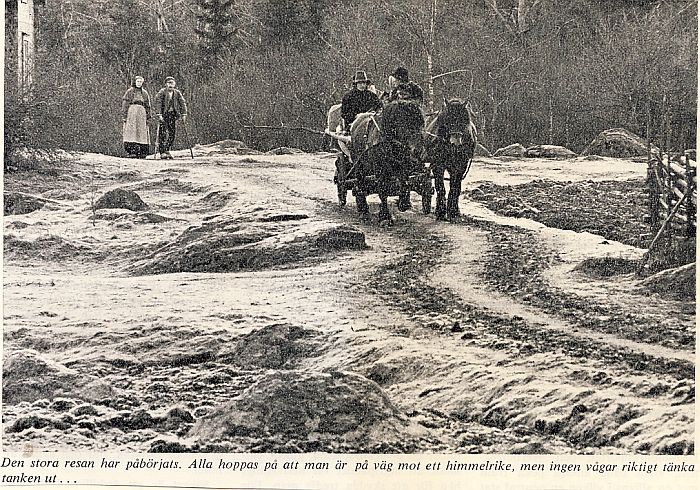
The old world

"The big journey has begun. Everyone's hoping that they're on the way towards a heaven, but it's still too frightning to follow the thought to its end..."

For this I have to pick a perspective, which will prove to bigger task than it should be, so I'll start in the end where I came to think about it today, the books by Vilhelm Moberg. Emigrants, Settlers and Onto a good land, following a Swedish family, and some of their friends on their way from Sweden to their new home in the US, as part of the huge emigration wave in the 1800s. The family is in no way typical for the actual Swedes that left, yet the books have become somewhat of a representation of how it actually was. What Moberg was really trying to do was to capture the thought process which led to such a decision. But, it doesn't really matter what he was trying to do, as the book series took on a life of it's own a long time ago.

This is entertainingly similar to what the US has done to the old world. European history frozen in time to fit into the celebration of heritage. Coming across Americans and introducing myself as a Swede I often get the happy response of "I'm Swedish too!". Rarely is that the case however. As it turns out it's usually the greatgreatgrandfather. I'm sorry, but that doesn't make you a Swede. No offense, but it makes you an American with rather diluted Swedish heritage.

It confuses me a bit. Aren't Americans supposed to be proud over their country? Or is it the idea that their proud over, the fact that it had to be an active choice to move (yes, I know this is coming off as a bit racist as I'm talking about Americans as all being of European heritage. Go back and read what I said about having to chose perspective, again. Thank you for your cooperation.) Clinging to this history, celebrating the land of the forfathers. Lovely. But that has nothing to do with how Europe in general and Sweden in particular is, today. Look at this for instance http://www.lindstrom.mn.org/ It gives an unnerving feeling on being on the border of fact and fiction. Lindstrom is set where Moberg's emigrants went. They have a statue of Karl-Oskar and Kristina, and their bakery sells the original Swedish doughnut. Whatever that is, I couldn't tell you. But it is in fact typical, incoroprating something of the new land with something of the old. The Sweden that Lindstrom is trying to represent simply doesn't exist anymore. It's the Sweden of the late 1800s. The langugage has changed, the food has changed, the build up of society has changed.

And this is where I mean that (yes, I know only some) American get their "We're the most modern country in the world" attitude. As soon as we reduce the rest of the world to something it has been, rather than taking the time and effort and looking at what it has become and where it's heading as it asks of you to lift your eyes beyond your own back yard. In Sweden we have Hembygdsmuseum, emigrantmuseum, and so on and so forth, representing the times that fled, while Lindstrom has this as a sole representation of what has now become a modern nation.

The idea of relatives leaving their countries far, far away to come to a better place in Amerrikat isn't applicable anymore. It might have been for a short period of time. I'm not placing any values on which country is the best, but I surely prefer my own.

An anecdote; there's an emigration museum in Växjö corresponding to the immigration museum on the Swedish street in Chicago. I've been to both. I also visited the store, next to the museum, and never before had I been that happy to see Ballerina cookies and Kalles kaviar.

That is more true as to what Sweden is today, instead of pickled herring, aprons, clogs, milking cows and going to church. We go visit other countries, but we're generally quite happy to come back home. The vast majority of Swedes live in towns and cities, not on small barren farms. Now. Not then. I feel honored that the people of Lindstrom are so proud over their heritage, and I'm glad that I don't live in Sweden of 1871, but 2010. The US has changed too, it'd be naive to think that The Old World has remained the same.

Dec 27, 2009

Reruns, part two


Originally posted July 15 2009

De-sexualisation

Having overheard a conversation about exposed bodies and sex on tv I began to wonder how that can be concidered sexual. I, personally, don't get turned on by half dressed people on posters by the busstop or a kiss on tv. I really think that the more expore to nudity we have the less of a deal it becomes. The censorship also has another side. It pushes morals on us which we don't really need. When did sex become such a big deal? Is the Victorian era still to blame? Why do men blush of guilt and women of innocence?

I suppose I'm jaded. I remember feeling almost as if sex wasn't real at all when I lived in the US. It was something you heard about, sometimes read about, but it wasn't really real. What I did had nothing incommon with the things not shown. Why is it that when the act itself is shown it's (almost) always concidered porn? People fake things for us to see all the time, why is it so bad to see actors fake sex? We don't get hurt by the fake words they speak so why would we by that?

Who is it that sets these rules of what's ok to see anyway? Do they have sex? And who are we protecting and why? When I took ethnology we went on a fieldtrip to see houses from different eras. Only in the modern ones were there spaces for privacy. Perhaps it's as simple as sex becomes a sin only when it's possible to do it in private. I find it hard to believe people did it less only because of the stable boy sleeping by the fire because the house only had four walls and no rooms. Were they imposed by the fake morals of today?

We are animals. We eat in front of people, something I would concider to be somewhat more barbaric than being touched by someone you love and that loves you back. Society's rules apply to all of us. Wether we like it or not. But the more foreplay I see the less sexual I feel. Because that's really all we see, isn't it? A constant foreplay and no climax. Maybe it's just the climax that's a problem, not the act. I don't know. But it's really starting to annoy me.

What's the difference between the postergirls and the real girls half naked on the street? That's what made the whole conversation overheard so ironic. The girls must have been, I don't know, in their teens, barely dressed at all, and they were going to complain about the buscube ads to the company for showing too much skin. Maybe it's their budding feminism speaking. But I don't see the exposed skin in public domains to have anything to do with what I do in my bed at night.

Then it's the whole whore and madonna complex. That's another chapter, really, but I think it connects to the desexualisation of the common space in all. The ones being watched are the whores and the ones watching are the madonnas. It's so easy to judge and say it's wrong. But in my opinion only an idiot would by a product because the girl is hot. (Oops, I forgot, the world is full of idiots...) If we base everything only on one aspect life gets dull and flat. But noone really wants the raw naked truth. The real sex has no place in advertisting and entertainment. Barely even in porn. It's sweat, unmatched underwear, untimed orgasms and someone always falls asleep too fast. It's not the well puttogether act it seems. I can see why that wouldn't sell as much as a jock strap. But, really, do we need the misconceptions and the mystery. Everyone gets to fuck eventually, even the poor children we're protecting from erections and premature ejactulations.

When reality tv is so hot, that's still blanked out. Hear me America? You're doing it wrong! You're not protecting anyone, if you did you wouldn't have the teenage pregnancy rate you do.

Hear me Sweden? You're doing it slightly wrong too. I don't want to have sex in cars, on picnic tables, in the café bathroom, and I don't want the filth or watching others doing it.

That's really the core isnt it, why we don't see it, they don't want us to feel excluded. We can't participate in something we're only capable of watching. Better to make us think we're in the middle of foreplay and then we go home and have real sex. Where's the paper towel?

Dec 20, 2009

Twenty below and flurries instead of stars

Yes I know the whole world is covered in snow. Part of it at least. My part especially. It's freezing, it's snowing, the shoes are creaking. What happened?! Wasn't it summer just the other day?

I wish I could see some stars instead of the flakes dangling as if being held up by fishing lines, ready to be jerked back up like a theatre back drop, killing the illusion. Let us bow our heads and remember the summer passed. It was hot, it rained, there was music, it contained trips, books and my arms stretched towards the sky in an attempt to embrace it.

It'll be summer soon again and I'll wonder what happened to winter, I'll wonder how spring managed to escape me and life will change once more. Perhaps it's just the new year howling. I'm ready. Come get me. I don't fear you right this moment, but maybe it's the stage set up that makes me comfortable.

Dec 19, 2009

Good night Saab

Thanks a lot GM for pulling the plug on Saab. Trollhättan will die. Swedes will complain. Politicians will be blamed. Surely, it'd be nice to have saved Saab for nationalistic reasons, but to keep a company around that makes a loss of 37 billion kr in 10 years for nostalgic reasons (that's 37 000 000 000 kr) ... I don't know. Of course the news papers are filled with pictures from a golden era, poor people having worked for Saab for 35 years crying "Now what will I do now?". I'm sorry, but I can't answer that question. Get a new job maybe? 15 000 people will lose their jobs. I don't know if you know, but we're not that many people in this little country, so that'd probably even make a dent in the unemployment statistics.

My own idea of Saab doesn't have much to do with the one presented in the media. I remember my aunt's rusty Saabs, the ones with broken mufflers going up and down my street with screaming semi conscious teenagers in the back seat, the working cars of the farmers full of cow droppings and piglets. Not as glamourous as the sales pitch makes it sound is it?

The long term effects would be more interesting to investigate. Will the factory worker die out in Sweden? Will we have to be so centralized that the more rural areas will go the same route as the nostalgic idea of Saab to begin with. Is there no hope? Of course there's hope! Life goes on. It's perfectly fine to miss what has been, the days of safe employment, cheap housing and a sense of that all of Sweden is alive. Parts of Sweden have been dead for a long time. This is just another another nail in the coffin for landsbygdsromantik. Feel free to google that expression. I'm proud of my country, I'm proud over being a Swede. What I'm not so proud of is the tendency to become handicapped in situation where action is needed. The tendency to dwell on what has been. Saab falling apart has been rushing towards us as long as I can remember. It can't really be that big of a suprise.

Saab hasn't even been fully Swedish since the 1980's. In other countries the governments have supported the car industry with more billions, but not here. Kind of ironic when you think about it. But why should they? Saab wasn't technically Swedish. GM has had full ownership since 2000. Is it the Swedish governments responsibility to support a company that, yes has production in Sweden, but the profits end up in a corporate business? This is what the protest of the workers are. They should have helped more. How? I ask you how? Where's the limit? After that help would any company be eligable for help when they can't quite make it? Every little knick knack store, every plumber, every stable. It wouldn't work, would it? The rules should be the same for small and big. And I suppose this is what happens when those rules are applied.

There was a similar situation in the 1990's where the banks got bailed out. Only one bank made it completely without governmental support. If we're going to have a free market, why not let it be free? That is however impossible in Sweden.

We don't have minimum wages, yet employers can't shop around for the cheapest workers as it's regulated between the union and the employers, and no company would like to be black listen for low salaries. I'm all for being able to make enough money from your job to be able to support yourself, but maybe, if we had a roof for how much you should be paid, companies would be able to afford more workers, and unemployment'd drop. At least in theory. Don't be greedy. The more money you make, the more you can afford to spend, prices will go up, and you'll need a raise. It's called inflation. You might have heard of it.

So, good night darling Saab. I'm sure there'll be a special about you on TV soon and Sweden will cry for a car not many of us even wanted.

Dec 12, 2009

Fragments of an association game

Irony, writer unable to write. Solution, none in sight. Sight, something about seeing. Seeing, unclear. Unclear means grumbled. Like the waters on the east coast. Seaweeds chasing legs. Sun too bright. Blinded, blindfolded, tied up, captivated. Swept away. Swept of feet. Fall. Fall is over. Winter now. Cold. Fall. Classes in the fall. An ad that said Art and culturetrips spring and fall - Rome, Paris Provance and English castles and gardens. www.kwkulturresor.se. Something misspelled, but not in the translation. Misplaced. Disgrace. About those dogs. A horrid scene. Was the movie as good as the book? Can't remember. Always better in the head. A tune stuck, playing over and over. Memories on repeat, shuffle button activated. Ha. Ha. Ha. Ha. Laughter randomly shuffled. Wake up laughing. A deer the size of a mouse. A bite electrocuting. It was funny. Wake up laughing. Wake up laughing.

Irony, writer unable to laugh. The funniest clowns. Tears of clowns. Rainbowed tears. Pink popcorn? Like pink cottoncandy. Purple's a fruit. Yellow is a colour. Twenty years ago. The climate change. Unable to change. No change in the pocket. Pocket leaking. Catching a fish. Keep it in a bucket. Those seaweeds, like hands. Clinging to like drowning. Selfcritical drowning. Wash up. Wash out. Wiped away.

Click, click, click labels. Label me. Then I'd know.

Dec 3, 2009

For the sake of time

In Sweden we have the tradition of letting children take music classes, usually starting around 3rd or 4th grade. Getting to leave class to go toot a trumpet or bang a piano seemed like a waste of time. My best part of the day was when two bullies had lessons right after one another, they never came back on time and the room settled. Even back then I couldn't quite grasp the concept of musical notes, so I never learned. Not even playing twinkle twinkle little star on the piano or flute. According to my high school music teacher I'm not worthy of living.

I'm wondering how many of those people still play their horns, drums, clarinet or violin. Did they keep it up for long after it offered an escape from class or was just a ploy to make kids into musicians?

There were concerts too, endless concerts with instruments out of tune. The idea wasn't really to teach anyone to play well, it was more under the banderole that anyone can, everyone's good, if only they try. Those poor souls that didn't participate in the concerts were forced to listen, as I recall we were five children. Five to applaud twentyfive. Do the math for an entire school...

I would like to see some statistics for how it was in different parts of the country, and not only in this god fearing area full of farmers and factory workers. (Dear Molly, that was such an evil thing to say) But seriously, I have a point in that. Maybe it's more appealing to those who didn't have classical music around them anyway, to those whose mother didn't say "Listen to this sweetheart, can't you just hear how the build up fills your whole being and then explodes in your heart?", repeatedly playing the same symphonies over and over. And maybe I would have been able to enjoy the out of tune concerts myself had I not been dolled up as a child and taken to places a child had no place.

So I suppose I should be grateful that they were given the chance to discover the things I was given for free. Just like I had to learn to play soccer and hockey. I never would have gotten the idea to try had it been up to me. It saddens me that the activities I had an actual intrest in weren't part of the curricilum so the soccer nerds never had to learn to ride horses.

School isn't only about teaching you to read and write, it's also about showing you new things, something that doesn't have anything to do with your family and friends, a chance for you to grow and discover who you will eventually become.

For me, that ment I discovered I'll never be able to read music, and I ice skate better than I kick a ball and I have no personal use for the periodic table, but that's a completely different story. My love for books, words, music from another angle, cats and the colour red has completely different origins. Although, I will give school some credit for helping me with the basics of a different language.

Nov 28, 2009

The bottom of the barrel

There are plenty of things to worry about in the modern age, what clothes to wear, which shoes go with what, what should I do when I get a job, who should I marry, how fast does my Internet need to be, how many channels on TV, how big is my credit card debt, which celebrity is sleeping with who, what song is at the top of the charts, where should we spend the holidays, gas car or diesel, some of these questions are universal over time, some not so much, but the one we might take a bit too much for granted is how will I live, and where will I live.

Imagine not having a home. Imagine not having to worry about the curtains, the dishwasher, if that chair blocks the door, the heating or anything of such sort. Having a home does bring a lot of problems, but they should be a lovely chore. A home represents so much of who you are and what you've accomplished in life.

It's a place where you can keep your things so you don't have to carry them around, it's a place to rest and relax. It's a basic need. Housing now is different than it has been. Noone in the western world would like a place without indoor plumbing and a fire place as the only source of heat, but that is how it's been for more time than we've had dining rooms and second bathrooms. What we're used to today is just a blink of an eye of human time. It's more expensive than we'd like to have the things we refer to as being basic. Poverty shows in your lack of electronics and things. Why is it so hard to let go of the things to live a bigger life?

I find the most depressing shows on TV, and yes indeed, I saw one about being homeless, and just like with all my other fears I look straight at it. I wish I couldn't imagine being homeless, it's a curse of the vivid imagination that I can. Yes, I've lived in places too small to fit a goldfish, places where things don't work, places where I had to share space, but I have never been homeless, even if all my belongings have been packed in boxes.

Who do we loathe and avoid in the street? Those who don't seem like "us", those with greasy hair and stone washed jeans, What I learned from the documentary is that it might be even more important for the homeless interviewed to keep up the physical apperance, just to avoid those looks and the stereotypical view of those without homes.

Here I sit in a house with too many rooms. I'm still not satisfied, no, I have too much. My happiest times have always been times of nothings, it made the struggles worth while. From the outside I have a good life, but what do we know about the struggles of others?

I don't think that housing politics is the only explaination for homelessness, but it is more than likely part of it, and it's not the regional politics that's the issue, it's the national one. Also, it has to do with the reluctancy to move to other places here cheap places to live are available. That's how I manage to sit in a house with too many rooms.

A safe and adequate home should not depend on your financial status, it's a human right to feel at home, even if that home just happens to be one room to fit a life into. And no, people without homes don't "have themselves to blame", even though I'm not naive enough to think they themselves didn't have anything to do with it. Sometimes life just doesn't offer the second chances even after we've paid our dues. Hopefully my housing luck will continue even if it means I buy my clothes on sale, watch a TV I was given, have the heat set to low, eat falukorv and toast and only have basic cable.

Nov 24, 2009

Books, books, books


Thank God for Hjalmar Söderberg.

After reading who the winners of Augustpriset are this year, I must sigh. Congratulations however! Well done!

After being polite I can continue to discuss something else. It's clearly too predictable which kind of books which will win awards. Books written about minorities, and books about being a minority, or being oppressed. Be black, be a woman, be jewish, be whatever, and write a book about it, you're bound to win an award. Just a tip.

Anyway there's a certain kind of inflation in it, how many holocaust books do we have to read? How much kitchen realism? How many books about overthrowing racist ideas and laws? I'm hardly saying it's not important, but, what kind of favor are we really doing? If we are going to be equals shouldn't we do it on equal terms. Is the art of a book about a middle class man less art that that of a black working class woman? Shouldn't it really be about the way the writer uses the tool of language to compose something? All rhetorical questions, but that's besides the point.

In a way this is what I was trying to get at in my "on the other side of feminism" post, highlighting other groups is great, for a while, at one point in time it has to be normalized instead of marginalized, and the compensation has to stop.

I want to be good at what I do as a person, not as a woman. Perhaps the winners of awards should ask themselves why they won, is it because of literary talent, the subject of the work, the composition, or their place in the sliding scale of society?

I do not want the days back where writing was for the male upper classes alone, and I'm looking forward to the day where art is able to stand on it's own two feet instead of being a political beet.

Nov 17, 2009

Just sometimes.

Swedish has the same word for pray and beg. In a way that explains a lot of the relationship between the Swedes and our church. It wasn't until the 1860s that Swedish citizens had the freedom of religion. (I won't go into detail about who could join what and where they could practice their faith) And almost a 100 years later in 1951, they got the legal choice to exit the church. Still a majority is a member of the Swedish church, even though it doesn't have that much to do with religion. My reason for staying in it is that hopefully at least some of the taxes I pay to it will go to preserving the church records of population, you know, from way back when.

It's also an example of how faith has more to do with politics than personal beliefs. The public dictates what the Bible means. In order for the parish to remain inact the church must accommodate it, or they won't go. This is the part that changed with freedom of religion. It's the freedom to go with what you personally think, it has absolutley nothing to do with any god or religion. You disagree with the priest, no biggie, keep on looking until you find someone that does agree. In this, yes, I'm saying it, religion isn't constant! There's no pure essence in it, there's no right and wrong. As long as people are set to dictate the words of god the issues of man will be more prominent than the divine.

We can beg for forgiveness, we can torture our bodies and souls in the name of God. We can plea for mercy, dwell in doubt and remorse, but it doesn't really matter, there's always a place in time where some church would accept your shortcomings as being the action of God itself, but if you have bad luck the same will codemn you to burn in hell for all eternity. It's all about timing and location.

Let's do the simple example of homosexuality. Certain churches bring it to be a deadly sin, it's unforgivable. (Well, last time I checked it wasn't part of the capital vices...but what I think doesn't matter, just had to put that in there for some reason.) And then, there are other places and times where it's fine. I wouldn't say that all Swedes are perfectly ok with homosexuality, but it is in fact legal for them to get married in church here, and we do have a gender neutral marrige law.

People make religion, not God. It's simply a yardstick we use for morals. Does it mean that atheists have no morals? Of course not. Morals predate religion. The 10 commandments weren't taken out of the blue, they already existed when they became part of a belief system. And now there are so many different ways to dictate what God means, what God says, what God intended.

Just the simple fact that we have different paths as to what to believe, when it comes to Christiany we have how many branches or churches? Which one is right? If any.

I won't make it even more complicated by bringing in all the people who lived long before Christanity. I don't want to be such an ageist.

But just sometimes I'd really like to believe that there's a higher purpose of this life than life itself. That there is an utter truth, and that I've been wrong this whole time. Instead I'm bound to be my own goddess with an equal chance of begging and pleasing.

Nov 11, 2009

Abanonded places


Just like places can tell the story of the people who have lived there they can also tell the story of historic misconceptions. The economic upraises and falls, one day it just becomes impossible and people walk out the door and never come back. Taking pictures of this is, as we all know, a hobby for the urban explorers. Places frozen in time, but hopefully with lessons learned.

Read more at
http://jornmark.se/default.aspx?lang=eng or I should probably say, look at more at.

That's just an example though, I see no stagnation in mistakes made by mankind. We will simply never learn. At a time of monetary promises we do things that we know we shouldn't and let the following generations pay the bill. I went to school in the turmoil of the early 1990s and its resignation and surrender to the forces pushing. The industry collapsed and when my generation became aware of the world it was a world without jobs and hopes. Schoolbooks shared between students with too many errors in the texts to make it worth the read. Sound like a third world country? Hardly. Maybe my perverted love for books comes from learning what a luxury they are.

And now we're been there again for about a year. Please, when something looks too good to be true, it probably is. Don't buy into it.