Pages

Showing posts with label Literature. Show all posts

May 19, 2010

The historical disasters


History holds quite a few disasters. Wars, plauges, earthquakes, revolutions, tsunamies and social outcastness. Not forgetting something like the Titanic. To stick to that for an example for a bit. How long does the disasterness last? It's really sad all those people died, but by now they would all have been dead anyway. World war 2 is heading the same way, I suppose. Can it only remain a disaster while people are still around to carry on the legacy of it's horrors? In a way I think so. We can read about the black death wiping out a big part of the population, but without eyewitnesses it's kind of a dead story. A bit almost like a fairytale. Only to be remembered by words. Also the world was a very different place back then. That makes it even harder for us to relate to them. I have no direct relationship with any of these things. My life has been pretty safe when it comes to historical disasters, they haven't bothered me.

How does this relate to personal matters. Perhaps I let strange things bother me because I always get stuck in my own perspective. I haven't experianced wars. Not even any really nature disasters. Just a few storms with power black outs for a couple of weeks. Really no biggie if you compare. To me the personal disasters are the disasters. In a way I don't think it differs that much from the bigger picture. Even world war 2 was such a historical disaster because it consisted of a lot of personal ones. Every loved one taken away. That's something we can all relate to. It's only the way they went that differs really. The uncertainty of where life is heading might have been a bit overwhelming at times, but then again, there's safety in numbers right? Maybe it felt a bit better if you knew millions of other people were in the same shitsituation as you, you wouldn't feel so lonley.

It kind of reminds me of that book by Camus, The Plauge where one of the characters is concidering suicide before the town gets sick, and well, when they're all sick he finds some kind of peace of mind. Like they're all sharing his misery and that makes it easier to bear. I think that's why humanity keeps coming back and surviving these things. We do it together, we share the misery and we fight together to find a way forward how much we hurt individually.

In that context it's easier to understand the peaks of depression in a general population. When a society is doing well and things are good it's a double curse to be sad and empty. You don't have a place in that and you stick out even more. Karin Johannisson writes in her book Melakoliska rum that melancholy is a lack. Perhaps in a healthy society the lack that causes melancholy is a sense of belonging and being made abundant by the world you live in. Not saying that's the whole cause of it, and it also raises the question of what came first the melancholy or the sense of not belonging. I'm hardly qualified to answer that question! Though I think it's safe to say that there is a connection between mental unhealth and a lower position in society, shown for example as unemployment and/or lack of funds.

Will we look at the starvation in Africa the same way? A chance for the planet to get caught up and a new level to exist on. I doubt people 500 years from now will have a problem with that, no more than I have with villages being taken over by nature because all the inhabitants died in a disease I'll never risk contracting.

Perhaps it's a simple human need to have disasters. If they don't happen to us on a grander scale we create our own. Yeah, I really think so

The humanist


"Meaning is an inescapable notion because it is not something simple or simply determined. It is simultaneously an experience of a subject and a property of a text. It is both what we understand and what in the text we try to understand. Arguments about meaning are always possible, and in that sense meaning is undecided, always to be decided, subject to decisions which are never irrevocable. If we must adopt some overall principle or formula, we might say that meaning is determined by context, since context includes rules of language, the situation of the author and the reader, and anything else that might conceivably be relevant. But if we say that meaning is context-bound, then we must add that context is boundless: there is no determining in advance what might count as relevant, what enlarging of context might be able to shift what we regard as the meaning of a text. Meaning is context-bound, but context is boundless."

I think the previous quote is actually something to live by. We can apply it to all areas of life. Especially in conflict, and by conflict I don't mean arguments you have with your neighbour about your morning paper that always seems to vanish, I also mean the conflicts you have with yourself as in how to set your behaviour for a particular situation. Even though the quote comes from a literary theory textbook, I must widen what I believe that literature is. I won't go into detail as to what literature actually is, it it's not as straight forward as the general idea might have you thinking. So, if I in this context mean literature as something created by the human mind my interpretation might seem a bit more adequate.

What is the meaning of the things we say, do and think and how can we put that into perspective - how do we put ourselves into a context in which we can exist? Or, who are we, depending on the same?

Personally, I have a vauge idea of how I want to be perceived, even though at times it seems hard to mask those bits of me that don't fit into that picture. I'm hardly as mysterious as I seem to come off, I'm hardly mysterious at all! In the perfect context I'm in a surrounding with people matching my views and values, and in the presence of beauty, physically, a constant autumn with cats and deep windows. But there is no such perfect place. People will be who they are and I'm not taken into concideration, nor should I be. So why is it that I try to take others into concideration? The most loving way I can interpret that is that I am my very own Tintomara. I'm a statue that changes apperance depending on the angle from which you view her. The statue itself doesn't change, it's only so many different things depending on how you look at it.

This could possibly be the explaination as to why I feel exhausted after being around people, I read too much into everything, like a true humanist. A humanist is never quite satisfied, a humanist will always ask "Why is that?" and I will continue to do so, for the good of my own sanity. I'll always have more questions than answers, and I'm satisfied, to an extent, with that. There's no judgement of those with a different view of life even if I might as myself "Why do they have a different view of life?" and then I'll ponder that and come to absolutley no conclusion other than a list and five philosophical essays as to why it could possibly be so.

So, when I take a little too long to say Hello when greeted, don't get discouraged, I'm simply asking myself "Why is your head tilted in such a way?" like the true humanist I am.

Vänner på hyllor


Som barn är det enkelt att svara på frågan om vem du är. En hel introduktion till någons liv som ett ifyllande av mina vänner bok; favoritfärg, favoritdjur, favoritdjur och favoritlek.

Allt eftersom tiden flyter förbi blir vi inte vara fysiskt större, utan även mentalt. Förhoppningsvis blir det mentala spelfältet tusenfalt större än det fysiska. Så vad händer när frågorna byts ut mot sociala indikationer av status och framgång? De flyttas till hur tiden används och i vilkas sällskap, vad jobbar du med, är du med någon, Åh?, vad ska ni göra på semestern? Allt paketerat behändigt och lättförståeligt. Precis som sidor i en vänbok i spretig nyfunnen handstil.

Lika bräcklig kan vår identitet och individualism vara, helt enkelt för att frågorna ställs och vi ställer dem själva. Som de sociala varelser vi är lär vi oss snabbt hur man svarar på dem för att kunna hitta andra samtalsämnen, nu när vi är identifierade.

Men det finns ett annat sätt. För att underlätta resonemanget, låt oss föreställa oss ett hem med inbjudna gäster. Ett trevligt hem, ett sådant vi känner igen som efterbilden eller slutsekvenserna i Simon och Thomas. Lite extravagant smakfullt. Människorna i samma stil, trendigt eleganta. Som en evig inredningsdetalj, ibland ditplacerad med flit för att den ger en distinkt känsla av intellekt. En passande image för ett hem som följer strömmen och läser tidningens kultursidor som ett måste inte och av genuint intresse. Sedan, den andra varianten, där den är ett nödvändigt ting i samma anda som att kläder genererar garderober. Bokhyllan.

Påkalla igen minnet av vänboken, hur du innan du skrev dina svar läste vad de andra hade skrivit, på samma vis som du hindrar dina ord om du fått svaret ”vi har precis flyttat isär” när du på ett flyktigt vis frågat om familjeförhållanden och inte ger ditt inövade tal om kärlekens oövervinnerliga kraft. Redan när du fattade pennan för att markera häst visste du hur du skulle bli sedd av de som varit före dig. Inte alltid så att hästar var ditt favoritdjur, men du orkade inte riktigt förklara att du egentligen föredrog grisar.

Så, bokhyllan, ståendes i allas vardagsrum med uppradade ryggar. Vissa lästa, men precis som tystnad också är svar på en fråga säger de olästa titlarna också något om innehavaren. En levande identitet, ett bibliotek av saker som har tänkts och passerat. Är det pocketböcker eller läderbundna klassiker? Är det kokböcker eller Nationalencyklopedins alla band? Kanske hittar du, när du drar ut ett par av dem lite vid sand som den egentliga souveniren från en lat semester långt härifrån.
Har du några idoler? Blädder, blädder i vänboken, vilka idoler hade du, vilka kända namn kunde du med gott samvete säga att du delade din beundran för?

I det där hemmet så är inte allt valt med precision. Elementen borde kanske ha bytts ut för några år sedan, fönstret på långväggen kunde gott ha varit lite mer till höger, det skulle se så mycket bättre ut. Visserligen går det att justera till en viss gräns, större gardiner för att dölja elementen, soffan placerad lite snett för att få plats. Men böckerna – de är valda. Som skivorna där i skänken bredvid. De flesta är gamla nu, som de vänner som bjudits in till hemmet. Alla laddar väl ner sin musik nu för tiden. I goda vänners lag skrattas det en del åt minnen från den där sandsemestern och musiken som hördes då. Samma ljud om och om igen på radion.
Själva poängen är att det är lätt att identifiera, på samma vis som vi på en enkelt vis önskar identifiera dem omkring oss, med de enkla frågorna, med de enkla svaren. Böckerna passar inte in. Du kanske inte fick en gris, men du har i alla fall möjlighet att välja vilka böcker som ska stå i din bokhylla. Eller? Månne tar det längre tid att hitta en bok och ställa den rakt och i någon slags ordning beblandad med de andra än det gör att hitta en låt i otaliga versioner på YouTube, men är det egentligen någon skillnad i tillämpningen? ”Du bara måste höra den här!”, ”Du bara måste läsa den här!”. Hur många böcker äger du som du bara måste läsa på någon annans rekommendation, som du fått i present för den passar dig så väl? Det måste väl vännerna som besöker hemmet veta, de vet ju allt om dig, vad du jobbar med, vem du är med och Åh?, vad ni ska göra på semestern.

Att äga samma saker i olika exemplar skapar en känsla av samhörighet, en ytlig sådan. Du har likadan Billybokhylla som jag har, vi måste ha så mycket gemensamt! Nämen titta, samma reproducerade bild av Munchs Skriet. Vi delar säkert vedermödor och livssyn, annars skulle du haft en gul orkidé medan jag har en rosa.

Jag föreslår helt sonika att vi gör så här när vi är i ett hem eller har ett hem och placerar potentiella vänner där tillsammans med oss själva att vi tar fram en illa sliten idé om en vänbok och börjar från början. Men inifrån, som när vi var barn och ställer samma frågor och väntar på längre svar, stående framför bokhyllan. Ta fram en i taget, vänd och vrid. ”Har du läst den, varifrån kommer den, varför står den här, där alla kan se den och inte nedpackad i en kartong?”. Som när din vän klädd i sval elegans håller upp Svindlande höjder och du ler åt andra minnen än de boken i sig håller. Låt orden snubbla förbi vem som satt i receptionen förra tisdagen och ge er hän i en virvlande fantasi om längtan och saknad. Om ni måste blanda in verkligheten så gör det med finess, känn igen dem genom gestalter ni läst om. Vi använder fraserna redan nu. Moment 22, att vara fast i en mardröm av Kafka, kvinnosyn som förordet till Giftas. Böckerna är skapade med samma mänsklighet som vi lever, så istället för att kyligt gå förbi dem på väg till den sneda soffan, stanna och fråga.

Inte sagt att du måste pressa dig igenom Krig och fred innan nästa middagsbjudning, men ge dig själv en chans att inte bläddra tillbaka och se vilka idoler du borde ha utan inspirera med din entusiasm över den nyupptäckta värld. Hur du än vänder och vrider på det så blir det din värld. Där filmen levs i samma takt oavsett vem som ser den, så är boken, hur generisk hyllan den står på än är en individuell upplevelse i en individuell takt. Och vad skulle vi prata om ifall alla tyckte likadant och tänkte på samma sak?

Vilket var det andra sättet, om man inte alls önskade fråga? Jo, se till att ha läst allt som finns i den där bokhyllan, studera sedan vederbörandes exemplar noga så vet du nog vad denna tycker om det mesta. En helt annan sorts vänskapsböcker

Apr 3, 2010

On the topic of love, for Molly


The other week my professor going on about the different ways to comparatively relate to the I in the text and the rest. It goes something like "The I and the world", "The I and the I", "The I and the language" and the "I and ideals". I can't quite remember because I didn't fully agree, a bad tendency I have is to not always listen when I don't agree. But either way they can be applied to other arenas as well. Today for instance, this post is "The I and the I and the you". But more honestly "The I and the I", because what I feel is something that I hold myself, and can't really be shared. That doesn't necessarily mean that noone understands. There's always someone that understands, like I've said a thousand times, the worst things you can do is assume that you're that special that noone can relate to you. Neither am I. However, right this very second I'm just plain me, stripped down and emptied. Not because of lack, no no, but because I have nowhere to put it. The voids in me aren't the adequate containers, so I must turn the heat down and just simmer for a while. So rational, darling Molly, do you drown yourself in rationality when you let go of all other things you could possibly hold on to? Yes, indeed I do. Simply because I know what's on the other side I attatch myself to the rational part like an overcooked noodle to hair. Now be quiet so I can continue being rational.

Love is when happy things make you cry, when a tickle makes you so angry you want to throw up. Love is when you know that sometimes love is not enough. Love is accepting that you can't be the air that someone breathes, the only thought, the understanding that you can't be everything to someone else. Because surely, you're not enough even for yourself, are you? Love is when you pout because you ruined your own suprise, just because you know someone well enough to know when they're planning a surprise. Love is being able to pout, but also being able to give something up for someone else. Love doesn't complete you, it doesn't make you whole, it's simply the water when you're thirsty, but once that desire is satisfied it's due to come back. What might have seemed like a wind up doll gets worn out and you must try harder, and the harder you try the bigger your perspective gets, and those details aren't only details but the essence of the life you built. Together.

Later, you'll find that for some reason the building blocks started to crack, way down there in the foundation, while you were piddling on top so you must dive down, deep under the sea to see to them. In doing that, someone must stay at the surface to make sure the whole building doesn't collapse. No more sorting the very top then. Even if not in the same place the same goal is at sight, even when it might not feel like it when you have your head buried in the sand.

Even though it's hard to, you're able to, you have to as failure is not an option. I don't fail. I fall down and break bones, but only because it's part of the game. And while I see other constallations just starting, others thriving, some treading carefully, some one sided, some including lies, I avoid looking at myself and just what it is that I have. Or had. Or will have. That is something I do in fact have at the moment, past tense, present and futurum. Basically life and love are grammatical errors about timing and chances.

It's all texts and textures, interchangeable but irreplacable. So maybe later, one day you'll help me change the textiles, I can't quite reach myself, and I know you don't like me climbing on stuff, you know, due to my tendency to fall down.

Mar 16, 2010

For Cathy on the topic of true love

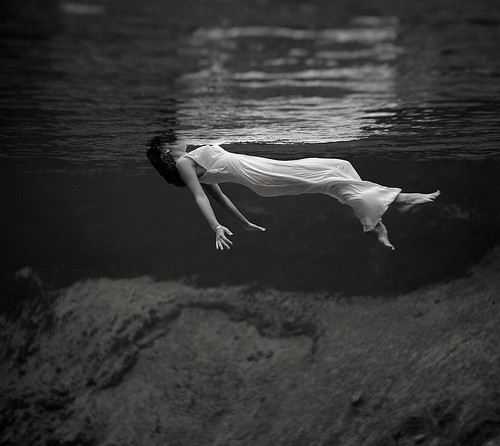
Just like the image suggests, a face over the surface is what keeps the body under alive, the streams washing you away, along, someplace else. The idea of soulmates is old, like Symposium by Plato, where people originally had four legs and four arms and two heads. They were then seperated, and we're doomed to search for the other half to complete us. Almqvist speaks of the same in the dialogue between the doctors in The Queens Tiara, even though the point of that was more to illustrate the question of what human is. For what is human, and by illuminating the humanism, you eventually end up by the other question of what does a human need? A sense of purpose, a sense of belonging.

It's, to me at least, debatable if we really need a purpose at all, because the only purpose we have is to stay alive and wait, keeping our faces over the surface to see just how long we last. That kind of waiting can make you lonely, so of course there's a need to theorize what we should spend our time doing, what becomes valuable when there's really no need, nor purpose for staying afloat, whether or not you find that in a person that doesn't care if you put on pyjama pants the second you get home and let your hair get really dirty because "it's so good for your scalp". The need for such person is the same as wanting to be acceptable even in your lowest moments. To think that there could only be one such a person throughout that long walk of life makes the idea of soulmates and true love seem so small to me.

As long as you're willing to accept that human life has no higher purpose that be alive all the days you're living, just like a cat finding the only ray of sun on the floor in the entire house and twirling in it, you can also accept the idea of soulmates and unconditional love. There is no unconditional love in the way it's portayed in art. The sorrows of young Werther comes to mind, he suffered endlessly because he was fixated on a particular kind of love. Just becuase someone's willing to die for it doesn't make it right. Being able to bring life to one another during the time you share, short or long, and accepting yourself, with or without someone kissing you even when your bikiniline is out of control is way bigger than putting your eskoliven in someone else's breakfast bowl.

Mar 8, 2010

International women's day


First a couple of sentences about Victoria Benedictsson. I was given the task to make my own literary canon. An impossible one as I found myself getting tied up in perspectives, but I lovingly remembered the first time I read Ur Mörkret, a sad yet perfectly composed story about a girl being brought up by her father and how she eventually came to detest her own gender simply because she couldn't live up to a male ideal. It's hard to be forgiven for being born a woman.

Then, today is also International women's day. Not the day for international women, but a day to remember that the fight for equality is very much still fought, every day still. So I mentioned it to an American friend, that appearantly never heard of it. That's a disgrace. In the sexual revolution the US was on top, women's rights were a big deal, women's camps and conferences, last time I heard about this part in modern history is when I listened to the P3 documentary about the history of female orgasm (if you know Swedish you can download it here) All I can think to ask is, what happened?! International women's day was always a big thing in school, as was UN day, and I grew up in the least gender equal part of Sweden, it still is by the way, it was in the news today, even.

Maybe it doesn't even matter what happened, it just reminds me that the world is hardly ready for the post feminism era. Either way I wish all women would get the chance to do with their lives as they please and don't feel forced to bleed on their wedding night. The idea of hymen is just another myth to control women's bodies, and deprive them of the human right to be their own masters. A woman's body is never quite her own, is it? There's always someone having an opinion on how it should look and what she should do with it. Again, that's why we need this day to begin with.

Mar 2, 2010

The constant and the change, the literary canon

With inspiration from this debate, I will do a twist, and whine a bit. I don't care for Jack Kerouac even though I own three editions of On the road. I'll sum up the plot for you if you haven't read it, they travelled, they fucked, they worked they got high, they travelled, they fucked, they travelled they got high and they worked, they fucked and they travelled. Suprisingly similar to The Lord of the Rings triolgy where the plot kind of goes they walked and they walked and they walked and they walked, they fought, they hid, they walked they walked and they walked. That pretty much sums up my idea of American literature. The grand travels. You can also see Frodos change as a matter of intoxication and the similarity to On the road is even more evident.

Who am I to judge these, oh lord, I don't want to use the word, but I know I'll be criticized if I don't, masterpieces? I'd say I'm noone better than to pass this judgement as they, in different ways represent what my parent generation valued. Please don't confuse what I call the parent generation with my own parents. I'm not narcissistic enough to bring my own parents into this, and leading that into that I'm only one voice among many. That is what the canon is. Voices. Then you can divide it into two things, what they're saying and how they're saying it. Historically the way they're saying it has a longer staying power than what they're saying. This is why I think that in 150 years On the road will only be a parentheses in the history of literature. Compare it to Crime and punishment by Fyodor Dostovesky (ugh, that is the ugliest spelling of his name) and how Crime and punishment in this offers a different perspective. Yes the plot is very introspective but it offers lessons to learn, something On the road only does to those who can directly relate to it. That generation will fade and the importace of the book will with that fade as well. Surely both books are best enjoyed before your mid 20s of the idealistic idea is lost. They can both be used as tools for the adolescent to find a place in the world, a sort of companionship in the state of being an outsider. Stylstically neither of these works compare to the sonnetts of William Shakespeare or Homerus. When context is lost the how remains.

Good quality literature embrace both of these elements, which is why Shakespeares comedies aren't as funny today as they were when they were written. Without understanding the life in the elizabethan era we can't understand the humor. Just like the French classicism dramas by Molière weren't about the ancient Greeks, he simply used a known and admired concept to tell the stories that'd suit the French upper classes in the 1600s. They tell us more about the lives and issues of them than they do of their heritage. I'm fully aware of the fact that the ideas I'm presenting aren't new, yet there's an essence of reinventing the wheel in any literary discussion. Everything has already been written, every style has been tried.

This is what the modernists had issues with. When everything's already been said but I still have things left to say, how do I go about that? And how, in a post like this can I fail to mention The Wasteland by T.S Eliot, which to me is the perfect example how you can use all the stories already told to tell something new. The Wasteland has what On the road lacks the most, depth. The fact that everything has already been written isn't a hindrance in producing excellent literature, but just like you don't start designing a car by pondering inventing the wheel you can't start from fresh without looking back. As simple as doing footnotes in your dissertation to show you're aware of where the information came from you weave the past into your text and do in fact create something new. That new will not have the same staying power as the original.

Compare that to scientific studies, which ones cause the most outbreak? The first study to show that smoking is bad or the one million following confirming the same thing? This brings me to the debate itself, the one about the literature of the Swedish working class where in the 1930's the writers hit a core in Swedish society with their bare realism and suffocating descriptions of the every day lives of the poor, but only in embracing the culture of the higher classes, the novel, did they get a chance to do so.

After the initial intent of the genre, to publicly show, to gain a greater audience for the issues at hand, what has the working class literature had to deal with, what can it offer now? It goes back to the discussion of how and what. Were these novels so sovereignly written that they deserve a place in the canon? Or do the stories of how actually fall under the category of social history and ethnology? Where is the line drawn between literature and other cultural expressions worthy of preserving?

Feb 16, 2010

So much for cultivated beings


For the 50+ years the UN has had peacekeepers out in the world it's been going on, sexual relations between the soldiers and the people they're set to protect. Last year Swedes were sent home for this very reason. Even though they know it's not allowed they do it, still.

I have one main question, and then some following: Why are you such horny fucks? Can you not hold it until you get home, or are you so rejected by your natives that you feel like you reached heaven when poor women are available? Nevermind world peace as long as I get laid, is that an idea the UN should stand for? Of course not. Are all inhibitions tossed out the window when put in the heart of darkness? Perhaps Joseph Conrad was on to something. The consequenses don't seem to be enough of an issue to stop the behaviour.

In Kongo Kinshasa the very center of the mission is to keep the women safe. Rape is just a war strategy, one that won't be met with guns. It's using women from two different angles. Getting them to do what you want with money or a dream of a better life somewhere else, or planting the seeds of militia in the wombs of thirteen year olds, the victims are still women. Not in one of the world's most poor countries, but the poorest country.

In lack of better alternatives we rely on help organizations as well as the UN to do the right thing, but when the good guys are breaking the rules, what can we put our faith in? And first and foremost, who will fend for those who can't fend for themselves?

Jan 15, 2010

Memento mori

What do Mozart, Beethoven, Emmanuel Swedenborg and Goya all have in common? Apart from being dead, their skulls have been sold, traded and kept. A skull to remember mortality. A full skeleton is closer to a jestering creature, compared to the staring of hollow empty eyes.

In art in general the skull is there to remind us, the world's most famous skull, featured in Hamlet. Yes, I'm aware of the fact that I've sort of seemed like the most morbid person in northern Europe lately, but I promise it's not about that. We see things in oppposite pairs. Love-hate, light-dark, night-day, dry-wet, hot-cold and here - life and death. How can we see life without seeing death, and what symbol, beyond all other showcases death? The skull, naturally.

So I say, when Hamlet holds the skull of Yorick in his hand, he's actually holding life and speaking to the final frontier of it. Hamlet is all about death as it is. No need to poke fun, but the end isn't really that exciting, after death there is no life, it leaves no room to imagine what will come next. Something I personally admire in a text, how it manages to attach itself to my mind and continue evolving into something completely different.

Back to death. It is fair. We will all die, and in death we will all be disgusting, we'll all decay, fade to dust, feed the worms, whatever. There is a comfort in that, opposites again, the cliché of "Life isn't fair", must by these standards mean that death is. And it will happen to all of us, might as well get used to the idea.

They kind of go together though, don't they? Memento mori, carpe diem.

Jan 12, 2010

Poems I wish I had written, part five

Kväll - morgon
Tomas Tranströmer

Månens mast har murknat och seglet skrynklas.
Måsen svävar druncken bort äver vattnet.
Bryggans tunga fyrkant är kolnad. Snåren
dignar i mörkret

Ut på trappan. Gryningen slår och slår i
havets gråsetensgrindar och solen sprakar
nära världen. Halvkvävda sommargudar
famlar i sjörök.

(Evening - morning

Moon - its mast is rotten, its sail is shriveled.
Seagull, drunk and soaring away on currents
Jetty - charrel rectangular mass. The thickets
founder in darkness.

Out on doorstep. Morning is beating, beats on
oceans' granite gateways and sun is sparkling
near the world. Half smothered, the gods of summer
fumble in seamist

Translated by Robin Fulton)

In all honesty, that translation does not capture the original at all.

Poems I wish I had written, part four

Storm
Tomas Tranströmer

Plötsligt möter vandraren här den gamla
jätteeken, lik en förstenad älg med
milsvid krona framför septemberhavets
svartgröna fästning

Nordlig storm. Det är den tid när rönnbärsklasar
mogna. Vaken i mörkret hör man
stjärnbilderna stampa i sina spiltor
högt över trädet

(Storm
Here the walker suddenly meets the giant
oaktree, like a petrified elk whose crown is
furlongs wide before the September ocean's
murky green fortress

Northern storm. The season when rowanberry
clusters swell. Awake in the dakrness, listen:
constellations stamping inside their stalls, high
over the treetops

Translated by Robin Fulton)

In all honesty, that translation does not capture the original at all.

Jan 2, 2010

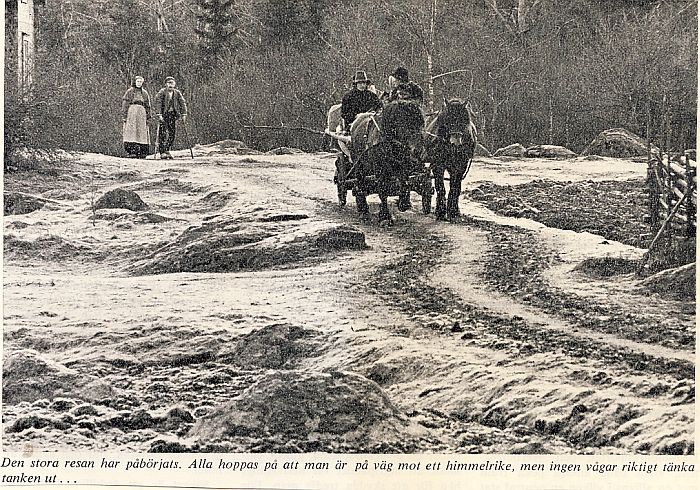
The old world

"The big journey has begun. Everyone's hoping that they're on the way towards a heaven, but it's still too frightning to follow the thought to its end..."

For this I have to pick a perspective, which will prove to bigger task than it should be, so I'll start in the end where I came to think about it today, the books by Vilhelm Moberg. Emigrants, Settlers and Onto a good land, following a Swedish family, and some of their friends on their way from Sweden to their new home in the US, as part of the huge emigration wave in the 1800s. The family is in no way typical for the actual Swedes that left, yet the books have become somewhat of a representation of how it actually was. What Moberg was really trying to do was to capture the thought process which led to such a decision. But, it doesn't really matter what he was trying to do, as the book series took on a life of it's own a long time ago.

This is entertainingly similar to what the US has done to the old world. European history frozen in time to fit into the celebration of heritage. Coming across Americans and introducing myself as a Swede I often get the happy response of "I'm Swedish too!". Rarely is that the case however. As it turns out it's usually the greatgreatgrandfather. I'm sorry, but that doesn't make you a Swede. No offense, but it makes you an American with rather diluted Swedish heritage.

It confuses me a bit. Aren't Americans supposed to be proud over their country? Or is it the idea that their proud over, the fact that it had to be an active choice to move (yes, I know this is coming off as a bit racist as I'm talking about Americans as all being of European heritage. Go back and read what I said about having to chose perspective, again. Thank you for your cooperation.) Clinging to this history, celebrating the land of the forfathers. Lovely. But that has nothing to do with how Europe in general and Sweden in particular is, today. Look at this for instance http://www.lindstrom.mn.org/ It gives an unnerving feeling on being on the border of fact and fiction. Lindstrom is set where Moberg's emigrants went. They have a statue of Karl-Oskar and Kristina, and their bakery sells the original Swedish doughnut. Whatever that is, I couldn't tell you. But it is in fact typical, incoroprating something of the new land with something of the old. The Sweden that Lindstrom is trying to represent simply doesn't exist anymore. It's the Sweden of the late 1800s. The langugage has changed, the food has changed, the build up of society has changed.

And this is where I mean that (yes, I know only some) American get their "We're the most modern country in the world" attitude. As soon as we reduce the rest of the world to something it has been, rather than taking the time and effort and looking at what it has become and where it's heading as it asks of you to lift your eyes beyond your own back yard. In Sweden we have Hembygdsmuseum, emigrantmuseum, and so on and so forth, representing the times that fled, while Lindstrom has this as a sole representation of what has now become a modern nation.

The idea of relatives leaving their countries far, far away to come to a better place in Amerrikat isn't applicable anymore. It might have been for a short period of time. I'm not placing any values on which country is the best, but I surely prefer my own.

An anecdote; there's an emigration museum in Växjö corresponding to the immigration museum on the Swedish street in Chicago. I've been to both. I also visited the store, next to the museum, and never before had I been that happy to see Ballerina cookies and Kalles kaviar.

That is more true as to what Sweden is today, instead of pickled herring, aprons, clogs, milking cows and going to church. We go visit other countries, but we're generally quite happy to come back home. The vast majority of Swedes live in towns and cities, not on small barren farms. Now. Not then. I feel honored that the people of Lindstrom are so proud over their heritage, and I'm glad that I don't live in Sweden of 1871, but 2010. The US has changed too, it'd be naive to think that The Old World has remained the same.

Dec 29, 2009

Poets are people too

I found myself reading about the movie Bright Star. I really have no desire to watch it, it's about John Keats, and his greatest love. I don't want his greatest love to be a person. I don't want him to have been a person. He's a name in books I read, occational founder of quotes I use. But a person, no.

William Shakespeare isn't a person. Karin Boye isn't a person. Edith Södergran isn't a person. Nelly Sachs isn't a person. Thomas Tranströmer isn't a person. Bruno K. Öijer might be a person. Kristina Lugn isn't a person, for sure. They're words, words, words, endless words for me to rip apart and make mine.

The endless constructions of life, lust, love, fear, hate, discoveries, melt downs, travels, transformations, they're nothing but means for me to see the world differently. It's not about the poets. There are plenty of excellent poets that never get read, those with perfect ryhmes and verses that never get read because they don't speak.

IN A STATION OF THE METRO
Ezra Pound

The apparition of these faces in the crowd ;
Petals on a wet, black bough.

Knowing the poets only gives a false sense of understanding. We can't feel what they felt. Did Shelley have intentions or was he just high? What's my intention when I write? None. I have no intentions. I just do it. And I would hate for people hundreds of years from now to remember those words of mine
"and those shoes I wear
laces cut like
the hair on the barbers floor
died before it leaves the skin"
and have them mean anything bigger than what I thought of on a dreary day when nothing else would work. Yet that is exactly what I'm doing to the lot of them, I'm depriving them of their humanity for my own selfish reasons. My own wish to make sense of the world via words of others, because the non existant God knows I can't manage it by myself.

Telling myself I'm not a poet is a way to preseve my individuality, yet, I'm just like everyone else. Telling myself I'm none of those labels that define me is my rebellion, but all I can rebel against is myself. Utterly useless.

THE MOON
Percy Bysshe Shelley

I.

And, like a dying lady lean and pale,
Who totters forth, wrapp'd in a gauzy veil,
Out of her chamber, led by the insane
And feeble wanderings of her fading brain,
The moon arose up in the murky east
A white and shapeless mass.

II.

Art thou pale for weariness
Of climbing heaven and gazing on the earth,
Wandering companionless
Among the stars that have a different birth,
And ever changing, like a joyless eye
That finds no object worth its constancy?

We should write what we know. I know nothing but the wor(l)ds of others, I'm not naive enough to think mine matters so in order to make the wor(l)ds mine I must kill all the poets.

Oct 8, 2009

Nobel prize in literature 2009

Ah how darling to listen to it, Herta Müller. "who, with the concentration of poetry and the frankness of prose, depicts the landscape of the dispossessed"

I'd lie if I said I've read her books, I'll be frank and say I haven't. But, I will. How can one resist titles like The devil is sitting in the mirror, The pale gentlemen with their espresso cups, Traveling on one leg and A warm potato is a warm bed. Pardon the bad translations...

Congratulations! (no, I'm not jealous)

Sep 29, 2009

That's so funny! ...isn't it?

funny pictures of cats with captions
see more Lolcats and funny pictures

humour or US humor
Noun
1. the quality of being funny
2. the ability to appreciate or express things that are humorous: a sense of humour
3. situations, speech, or writings that are humorous
4. a state of mind; mood: in astoundingly good humour
5. Archaic any of various fluids in the body: aqueous humour

Nevermind no 5. But hey, I didn't know about that, you learn something new every day. It's come to my attention that it's sometimes hard for strangers to tell when I'm joking. It's called dry humor people! When a joke is told without the face or tone of voice giving away that it is in fact a joke.

An example from the beginning of the semester before last. Picture this, 10 students, drinking coffee at a table made out of stone talking about politics. It's agreed that the heart is to the left, meaning that nine of the people around the table has said their share about the topic and Vänsterpartiet (http://en.wikipedia.org/wiki/Left_Party_(Sweden) ) is the political party they all favor, then the 10th student says "But I find Fredrik Reinfeldt so charming and his politics are so right for Sweden in this time, so I voted for Moderaterna" (http://en.wikipedia.org/wiki/Moderaterna) which is at the total opposite of the political spectra. Without giving anything away the 10th student takes a sip of coffee in silence and looks out the window feeling the sceptical eyes of the nine others when the air is still. Then the 10th student smirks and says "If you could see the looks on your faces, priceless!" Now all ten students are laughing in unity.

Unity must be the goal of humor and in the example the 10th student provided just that, the relief of laughter in a tense situation before everyone knows each other. Maybe I took it a step too far being coy and letting them hang for so long, but I can't resist. These people then got to know me and would see when I was joking if something didn't go with my persona.

I also have a sarcastic trait. I don't concider sarcasm mean at all, it's a language you have to be familiar with to understand however. I will push jokes hard and say semi-mean things with the excuse that it was "only" a joke but the truth is that our prejudices show in the jokes we tell. I don't mind making a mockery of myself for the sake of a laugh. I really don't take myself seriously enough to worry about that, the politics joke could have lasted for a week or two, I could have built on it by showing up in overly snobby clothes and started arguments and acted the part of a moderat. Actually, it's a bit suprising that I didn't.

That being said, I don't understand all kinds of humor. Well, saying that I don't understand might be too much, but I don't find all kinds of humor funny. I don't care for sitcoms at all, nor sexists jokes because I firmly believe that as long as the ideas behind those jokes exist, so will the jokes. Best get rid of them. Nor do I find the chicken fighting scene in Family guy funny, it's too lengthy. Jokes that take too long with no added substance is nothing but dull. There's an unwritten rule in stand up comedy that you must make your audience laugh within 20 seconds or you've lost them. I think being funny outside of a stage is a bit different though, your "audience" isn't always aware of that they are in fact that to you.

Humor is also about emotion, so I do understand that what's concidered funny sometimes goes hand in hand with what's taboo, but for the same reason I don't like sexist jokes I don't always find that funny either. What's funny to me is the slightly ironic and complicated, the things that take some thought, so I usually produce most of my jokes in the shape of riddles.

I find puns mildly amusing even though I'm close to unable to produce a successful pun myself. I like to see humor as a bit of connect the dots, you have to pay attention to catch what's funny. Close to everything can be turned into a joke if you look at it as a cliché, the bigbottomed ladies in hiphop videos can be hillarious to me, so can the fact that it always rains when the hero and heroine first kiss in sad movies. It's oh so sad/romantic/dramatic/scary, take your pick, and there I am giggling.

I also like goofy things, like speaking for my cats in strange voices, or a fish wearing a hat. In fact, I would find it more amusing than strange to walk down the street wearing a duck costume. I laugh at myself when I trip and fall, or when I make a mess of myself by spilling coffee and I'm still laughing when it ruins my notebook so that all the pages stick together. It's just so typical.

Does this mean I have no sense of humor? I doubt it. Does this mean I sometimes make fools of others for the sake of a laugh? It's been known to happen. But when I do so, it's usually because I find the person rather funny, under the same category as I do clichés. I take a piss at those who take themselves too seriously, or try to belittle me. My defense is always humor, and at times my object bites and I can push the joke even further. Does this mean I'm a bad person? No, it means I'm a good judge of character. Do I like to ask rhetorical questions? Oh, yes I do.

I also believe we have two ears and one mouth for a reason, we should always listen more than we talk. Who knows which funnies we're missing when we're yapping away...